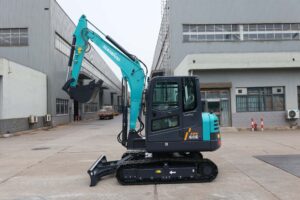
What Is a Skid Steer Loader?
A skid steer loader, occasionally called a skid loader or skidsteer, is a compact, rigid-frame, vehicle fitted with lift arms that can be connected to a wide variety of attachments. It is distinct from other construction vehicles because of its turning mechanism, which allows it to rotate within a very small space. Skid Steer loaders are commonly used for digging, lifting, loading, grading, and material handling across construction, landscaping, agriculture, demolition, and property maintenance projects.
Who are Spartan Machinery?
Spartan Machinery is Australia’s leading provider of high-quality machinery and equipment. We cover sales, service, and support for the construction, mining, and industrial sectors, offering a comprehensive range of advanced and reliable equipment tailored to meet the most demanding situations.
• Industry Expertise and Experience
• Comprehensive Service and Support
• Extensive Spare Parts Inventory
• Customer-Orientated Service
• Flexible sales, leasing and financing options.
• Construction vehicles such as excavators for sale or hire
Why Are Skid Steer Loaders Different?
Unlike larger wheel loaders, a skid steer is specifically designed for confined areas. Its compact size allows it to operate in narrow accessways, indoor job sites, small construction zones, and residential properties where larger equipment could never fit. The two main reasons for this are the unique steering system, and the mounting of the lifting mechanism at the back of the vehicle. Despite its small footprint, a skid steer loader can lift reasonably heavy loads, making it a practical and efficient vehicle for many situations.
How Does a Skid Steer’s Steering System Work?
A skid steer vehicle, as its name suggests, has a unique steering mechanism. Almost all other vehicles will steer by pivoting the front wheels. A few vehicles will pivot the back wheels. But the skid steer keeps all four wheels (or sometimes tracks) permanently fixed in position. It steers by increasing the speed of the wheels on one side of the vehicle while decreasing the speed (or reversing the direction) of the wheels on the other side of the vehicle.
This allows the machine to:
- Perform zero-radius turns
- Rotate within its own length
- Turn 360 degrees in confined spaces
- Change direction quickly and precisely
This makes a skid steer vehicle far more manoeuvrable in tight spaces than almost any other vehicle. Theoperator can, if required, drive the wheels on the left side forward and the wheels on the right side in reverse at the same time. This enables the machine to spin on the spot, a capability not available in conventional loaders. The disadvantage is that there is much higher friction between the wheels and the ground. This means that the tyres suffer a lot of wear, and that the ground (in some cases) is prone to damage.
What Is the Difference Between a Skid Steer and a Compact Track Loader?
There are two basic types of skid steer vehicles. They can have either four wheels or two tracks. The wheeled type is more common, but tracks offer advantages in some circumstances. The tracked skid steer loader is sometimes called a compact track loader. Choosing between them depends largely on the site conditions.
Skid steers with wheels:
- Better on hard surfaces
- Faster travel speeds
- Lower upfront and maintenance costs
Compact track loaders:
- Lower ground pressure, with pressure spread out over a larger area.
- Better traction on mud, snow, sand, and slopes
- Greater stability on uneven terrain
- Typically, a higher lifting capacity in similar horsepower classes
Why is the Centre of Gravity Important?
If a construction vehicle is to lift a heavy load, it must have two important factors: Firstly, it must have the mechanical strength to lift the weight. Secondly, it must be balanced so that the weight does not cause the vehicle to tip over. This balance of the vehicle is largely about the vehicle’s centre of gravity. If the weight is largely at the front of the vehicle, it will be prone to tipping forward. But if the weight is evenly distributed, the centre of gravity is effectively in the middle of the vehicle. So, it will be far less prone to tipping over, unless the load is extremely heavy. A steer shift loader has the weight, and therefore the centre of gravity, largely at the back of the vehicle. So, it will not be prone to tipping, even if there is a moderately heavy load at the front of the vehicle.
What Are the Advantages of a Skid Steer Loader?
- Compact frame compared to articulated loaders
- Lift arms positioned alongside the operator rather than in front
- Joystick controls instead of a steering wheel
- The centre of gravity is set far back, so the vehicle has very good stability.
- High manoeuvrability, even in small spaces
- Reasonably easy to transport.
- Zero-turn capability makes skid steers ideal for tight, confined, or indoor environments. They are especially useful in urban construction, demolition sites, and landscaping projects with restricted access.
- Wide Range of Attachments, so the one vehicle can perform many tasks.
Because the lift arms are mounted beside the operator and pivot behind the shoulders, modern machines include protective structures such as ROPS (Roll Over-Protective Structure) and FOPS (Falling Object Protective Structure). These features form a protective zone around the operator and are critical for safe operation.
What Are Some of The Skid Steer Loader Attachment Options?
A skid steer can connect to dozens of attachments, including:
- Buckets
- Augers
- Trenchers
- Pallet forks
- Hydraulic hammers
- Sweepers
- Snow blades and blowers
- Stump grinders
- Cement mixers
This allows one machine to perform multiple roles, reducing the need for additional equipment.
What are the Vehicle Size Options?
Skid steer loaders are available in several sizes, which roughly correspond to their load capacity and horsepower. We can group these as small, medium, and large frame models, with larger models being able to handle larger loads.
Small-frame models are suitable for light-duty and interior work, while large-frame models are capable of heavier excavation and demolition tasks.
Are There Any Disadvantages of a Skid Steer?
While highly versatile, skid steers do have limitations.
Ground Surface Damage
Because turning involves dragging the wheels across the surface, skid steers can damage soft or fragile ground. High ground friction may tear up lawns or unsealed surfaces. But skid steers are find on hard surfaces like roads or concrete.
Rear Visibility
While front visibility in a skid steer vehicle is quite good, the rear visibility is quite limited. Operators are trained to be aware of this blind spot.
Performance in Mud or Soft Terrain
It is true that skid steers with wheels can lose traction or become stuck in muddy, sandy, or swampy conditions. But skid steers with tracks can perform quite well in these muddy, sandy conditions.
Increased Tyre Wear
Because of the unique steering mechanism of skid steer loaders, the wheels will suffer increased wear, especially when making frequent turns.
Safety Considerations
The skid steer loader should only be operated by individuals with appropriate training. The operators require a statement of attainment, which can be obtained with a 3-day training course. The combination of limited rear visibility, zero-turn movement, and heavy loads means that rollover incidents and crushing injuries can occur if proper safety procedures are not followed. Features such as beacon lights, reverse alarms, seat restraints, and side screens significantly reduce risks when properly maintained.
What Situations Are Skid Steer Loaders Best Suited To?
Skid steer loaders are ideal when manoeuvrability, attachment flexibility, and compact size are priorities.
- Tight urban construction sites
- Indoor warehouse or factory work
- Demolition on hard surfaces
- Snow clearing on paved areas
- Landscaping and site preparation
- Material handling in confined areas
- Small to medium excavation jobs
Considering Skid Steer Loader Machinery Hire?
Skid steer loaders are one of the more adaptable vehicles used in the construction and Earth-moving industries. They have the advantage of compact size and high manoeuvrability, which suits confined workspaces. They also have the option of many different work attachments. For contractors and businesses, it is often more cost-effective to hire a skid steer loader than to purchase, but purchasing a machine is a good option if it sees a sufficient amount of long term. When selecting a machine, consider the ground conditions, the lift capacity, any attachment needs, and the transport logistics. Matching the right skid steer to the job ensures efficiency, safety, and cost control.